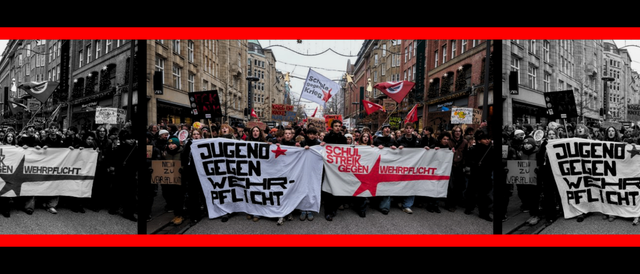
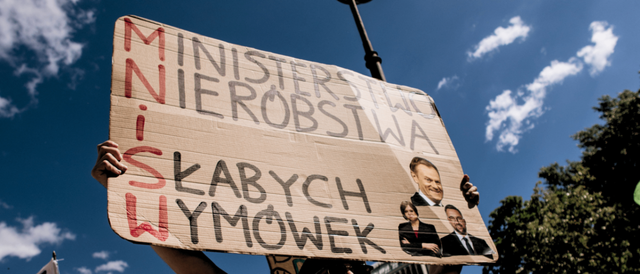
The right to objection to military service is inalienable. We call on the government to take action!
A letter concerning objectors and deportations to the front.
 Opór

12 August 2026
OPEN LETTER
Prime Minister,
We, the undersigned, urge the Government of the Republic of Poland to:
-
Abandon its plans to introduce legislative changes imposing severe penalties on soldiers for refusing to obey orders during mobilisation or wartime, as reported by the Polish press.
-
Introduce legislation guaranteeing the right to refuse military service on grounds of conscientious objection — not only in peacetime, but also during mobilisation and war.
-
Refrain from any potential deportation from Poland of Ukrainian citizens who declare that they refuse to serve in the Ukrainian armed forces on grounds of conscientious objection.
In mid-July 2026, the Polish press revealed that the government was planning legislative changes that would radically increase the penalties imposed on soldiers for refusing to obey orders during mobilisation or wartime. Under current legislation, insubordination may be punished by up to three years’ imprisonment; when committed jointly with others, the penalty may increase to five years. Under the proposed legislation, penalties for such offences could rise to as much as 30 years’ imprisonment, while the introduction of life imprisonment is reportedly also under consideration.
At the same time, the situation of people who refuse military service on grounds of conscientious objection – whether for religious, ideological or political reasons — remains legally unresolved in Poland. Since 1988, it has been possible to refuse military service on the condition that alternative civilian service is performed instead. Following the suspension of compulsory military service in 2009, however, the regulations concerning conscientious objectors were effectively left in a legal vacuum.
As a result, it remains unclear whether, in the event of war or mobilisation, people who previously performed alternative civilian service or were imprisoned for refusing military service – including during the 1990s – would be exempt from being called up. Nor is it clear what form any such call-up would take. Some of these people are still of an age at which they may be subject to mobilisation. Between 1988 and 2009, approximately 90,000 men applied for alternative service, of whom around 54,000 were granted it.
It should be noted that many Western countries recognise the right to conscientious objection to military service also during mobilisation and war, including Sweden, Finland, the United States, Canada and the United Kingdom. In the United Kingdom, this possibility was introduced as early as 1916. During the First World War, approximately 16,000 men applied for exemption from military service on grounds of conscientious objection; during the Second World War, approximately 65,000 men and 1,000 women did so.
Under international law and in accordance with the findings of bodies such as the UN Human Rights Committee and the Venice Commission (European Commission for Democracy through Law), the right to conscientious objection to military service is an inalienable right, including in wartime.
According to the Venice Commission – in its 2025 opinion concerning a Ukrainian conscientious objector – states have an unconditional obligation to establish and maintain a system of alternative civilian service that is separate from military structures and military command. National defence considerations cannot justify denying exemption or alternative service to people seeking it on grounds of conscientious objection, including during wartime.
In 2022, the Ukrainian authorities ceased to respect the regulations concerning conscientious objectors. The European Bureau for Conscientious Objection and the Ukrainian Helsinki Human Rights Union have drawn attention to violations of the rights of conscientious objectors in Ukraine. Thousands have been imprisoned or forcibly conscripted into the armed forces. In their reports, human rights organisations warn that people seeking recognition as conscientious objectors are often denied an effective right of appeal against decisions made by Territorial Recruitment Centres. They have also documented cases of torture and ill-treatment of people refusing military service.
The youth structures of the Workers’ Initiative Trade Union (Inicjatywa Pracownicza) firmly oppose war and will continue to take action for peace.